
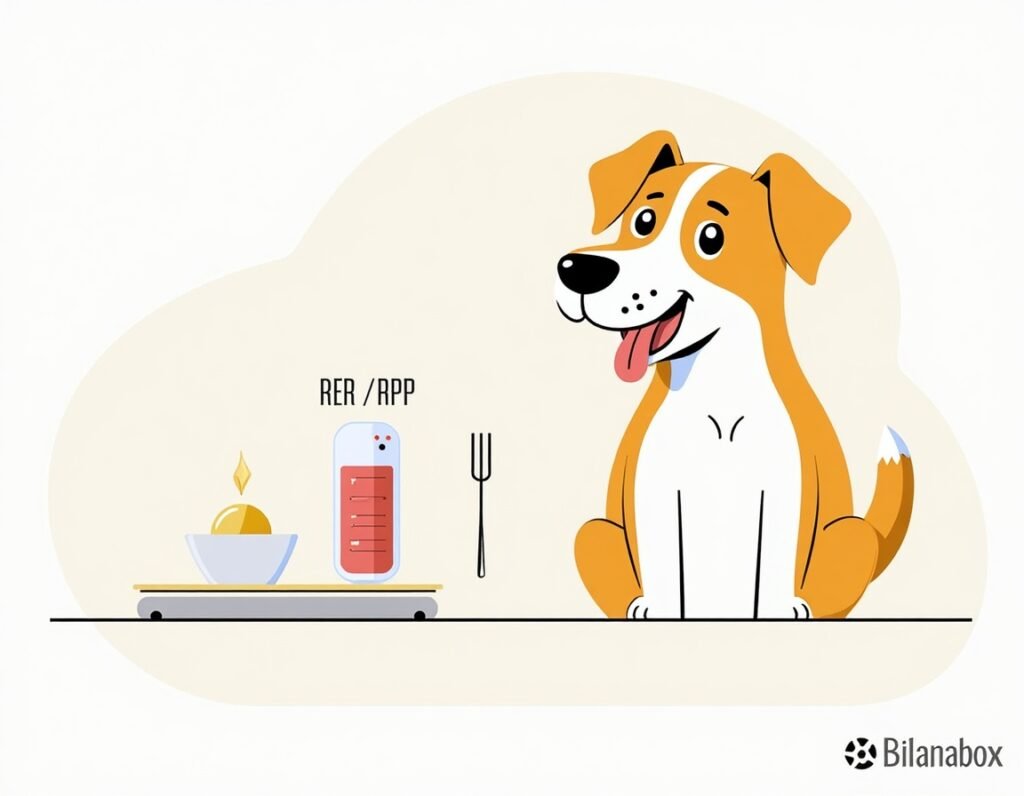
A dog calorie calculator provides a practical estimate of how much energy your dog may need each day. It uses information such as body weight and typical activity level to estimate daily calories, helping you make more informed feeding decisions and compare portions consistently.
The result is a starting point, not a universal prescription or an exact requirement. Your dog’s body condition, routine, life stage, and other characteristics can affect actual needs. Use the estimate alongside observed changes over time, and seek professional guidance when your dog has specific health or nutritional needs.
Table of Contents
What RER and DER Mean
Resting energy requirement (RER) is the baseline estimate of energy a dog needs at rest. It provides a starting point based primarily on body weight, but it is not automatically the dog’s complete daily feeding target.
Daily energy requirement (DER) is the adjusted estimate for the dog’s full daily needs. It builds on RER by accounting for relevant circumstances such as typical activity, life stage, reproductive status, body condition, or health needs when applicable. In simple terms, RER is the baseline, while DER is the broader daily estimate. Use DER as a practical starting point for feeding decisions, then interpret it alongside your dog’s condition and routine.
Information the Calculator Needs
Prepare current information before starting:
- Body weight: Use a reliable, recent measurement because weight provides the foundation for the calorie estimate.
- Unit of measurement: Select or enter the unit the calculator expects so the calculation is interpreted correctly.
- Life stage or relevant status: Provide requested details because they may affect how DER is adjusted.
- Typical activity: Describe your dog’s usual movement and exercise honestly, since activity helps shape the daily estimate.
Answer only the characteristics the tool requests, and use information that reflects your dog’s current situation.
Convert Your Dog’s Weight Correctly
Enter your dog’s weight in the unit the calculator expects. Pounds and kilograms are different units, so do not apply a formula to one while labeling it as the other. If your measurement uses a different unit, convert it before calculating and use the same unit consistently throughout the process. Weigh your dog using a dependable, current measurement rather than relying on an old estimate. An accurate starting weight helps the calculator produce a more useful RER and DER estimate.
How the RER Estimate Is Calculated
The calculator derives resting energy requirement (RER) from your dog’s current body weight using the calculation method configured in the tool. Because the specific formula is not shown in the available information, do not substitute a formula from another calculator or assume that every tool uses the same method.
In general, body weight is the measured weight entered into the calculation. If the displayed method includes a coefficient, that coefficient is the fixed number applied by the formula. An exponent indicates that weight is raised to a specified power rather than simply multiplied by one number. This means body weight affects the baseline through the formula’s mathematical relationship, not through a simple one-to-one increase. Treat the resulting RER as a baseline estimate; the calculator uses additional characteristics when determining DER.
How DER Adjusts the Baseline
Daily energy requirement (DER) is derived by adjusting the resting energy requirement (RER) to reflect the dog’s broader circumstances. Conceptually, the calculation starts with the RER baseline and modifies it using applicable factors, which may include activity, life stage, reproductive status, body condition, or health needs.
Activity is therefore one adjustment, not the only determinant of daily calories. A dog with a similar body weight may have a different DER because its routine, status, or nutritional needs differ. Select characteristics that accurately describe your dog’s current situation, rather than choosing a category based only on breed, size, or an unusually active day. The resulting DER is still an estimate to interpret alongside changes in body condition, weight, appetite, and routine.
Classify Your Dog’s Activity Level
Describe your dog’s usual pattern, not an unusually active day or a routine you hope to introduce later. Consider how much your dog moves during normal daily activities, how often they exercise, how intense that exercise is, and how well they recover afterward. A dog with brief, easy activity has a different routine from one that regularly participates in longer or more demanding exercise. Breed and size alone do not determine activity level, so base your selection on observed behavior and schedule.
If activity varies substantially from day to day or week to week, choose the category that best represents the usual pattern and treat the result as less certain. Monitor body condition, weight, appetite, and energy, then reassess the estimate if the routine changes or a consistent trend appears.
Use the Calculator Step by Step
- Enter your dog’s current weight using the correct unit.
- Select the applicable life stage, reproductive status, body condition, or other characteristics requested by the calculator.
- Choose the activity description that best matches your dog’s usual routine, including typical movement and exercise.
- Review each entry for accuracy, then calculate the RER baseline and DER daily estimate.
- Record the resulting calories-per-day estimate, along with the date and inputs used, so you can compare it with future calculations and monitor changes over time.
Understand the Result in Calories per Day
The displayed DER figure is an estimate of your dog’s total calories per day from all food consumed during that day. It is not the calorie allowance for one meal, scoop, or serving. If you feed two or more meals, divide the estimated calories per day among those meals according to your feeding routine. Treats, toppers, chews, supplements, and shared foods also contribute to the same daily total. Think of each meal as a portion of the estimated calories per day, not as a separate daily allowance. Use the figure as a starting point, then monitor your dog’s condition and routine.
Translate Calories into Food Portions
Use the food label’s calorie information to convert the daily estimate into an amount of food. First, check whether calories are listed per cup, can, gram, or another stated unit. Then divide the estimated daily calories by the calories in that unit. The result is an estimated amount of that food before accounting for anything else your dog eats.
Measure portions using the same unit shown on the label and keep the method consistent. Deduct calories for treats, toppers, chews, supplements, and shared foods from the daily total rather than adding them on top of the full estimate. If your dog eats multiple foods, account for each item separately and keep the combined calories within the daily starting target. Recheck the label if the product or serving information changes.
Why the Estimate May Need Adjustment
A calculator’s result may not match your dog’s actual needs because dogs differ in metabolism, body condition, routine, and response to food. Daily movement may also change, making an activity description less representative over time. Food digestibility and differences between products can affect how useful a calorie estimate is for a particular dog.
Input accuracy matters as well. An outdated or inaccurate body weight, an incorrect activity category, or imprecise portion measurement can lead to misleading conclusions. Numerical precision in the displayed result does not make the estimate exact. Treat the calculated DER as a starting point, then compare it with your dog’s weight, body condition, appetite, energy, and routine over time. Use those observations to determine whether the starting estimate appears appropriate and whether it should be reviewed.
Monitor Body Condition and Progress
After using the estimate, track your dog’s body weight, visible body condition, appetite, and energy over time. Also note changes in daily movement, exercise, or other parts of the routine that could affect calorie needs. Keep measurements and observations consistent where possible, rather than making an abrupt portion change based on a single result.
Trends are more informative than one reading. A stable pattern in weight, condition, appetite, and energy may suggest that the starting estimate is appropriate, while a consistent change may indicate that the estimate or feeding routine needs review. Seek veterinary input for concerning changes or when your observations conflict with professional guidance.
When to Recalculate
Recalculate the estimate when your dog has a meaningful weight change, a sustained change in activity, a new life stage, or a different feeding routine. This is a normal maintenance step, not evidence that the first estimate was useless. Update only the characteristics that have actually changed, and keep earlier results, dates, and inputs for comparison. Using consistent information makes it easier to identify whether a change reflects your dog’s needs or a change in the calculation.
Common Calorie-Calculation Mistakes
Small errors can distort an estimate without making the corrected result exact. Watch for these common problems:
- Data-entry errors: Entering pounds when kilograms are expected, or using an outdated weight, can affect the calculation. Confirm the unit and use a current measurement.
- Activity overstatement: Selecting an overly active category based on an occasional strenuous day may inflate DER. Choose the level that reflects the usual routine.
- Interpretation errors: RER is the baseline, while DER is the adjusted daily estimate. Do not treat them as interchangeable.
- Portion-accounting errors: Include treats, chews, toppers, supplements, and shared foods. Check current food calorie information and monitor outcomes before changing portions again.
Safety and Veterinary Considerations
A general dog calorie calculator may be less suitable when a dog has a medical condition, unusual weight changes, pregnancy or lactation, growth-related needs, or a prescribed diet. These situations can require individualized nutritional guidance and professional review. A calculator’s estimate should not override your veterinarian’s instructions or replace a prescribed feeding plan. Consult a veterinarian if the calculated amount conflicts with professional advice, your dog’s health status, or observed changes in weight, appetite, energy, or body condition. Reviewing the estimate with a veterinarian is especially appropriate when your dog’s health or life stage makes a general calculation less reliable.
How This Free Tool Saves Time
Automated RER and DER calculations reduce the need for manual arithmetic, helping you arrive at a daily calorie estimate more efficiently. The tool also makes it easier to compare feeding estimates over time when you reuse the same process and record the inputs. Automation is most useful when you can review the calculator’s assumptions and understand how weight, activity, and other characteristics affect the result.
What a Useful Dog Calorie Calculator Should Show
Use this checklist when comparing free dog calorie calculators:
Transparent inputs: The tool should show whether it uses weight, activity, life stage, reproductive status, body condition, or other characteristics.
Clearly labeled results: RER and DER should be identified separately so you can distinguish the baseline from the adjusted daily estimate.
Understandable activity categories: Descriptions should help you match the tool to your dog’s usual routine rather than guess from breed or size.
Consistent unit handling: The calculator should state which weight units it accepts and make conversions clear.
Visible assumptions: You should be able to see what the calculation used and understand what the result represents without guesswork.
A precise-looking number is not proof that an estimate is reliable. A useful tool reduces manual effort while allowing you to review its inputs, assumptions, and meaning.
Limits of Free Calculator Results
A free dog calorie calculator is a general planning aid, not a diagnostic tool or veterinary nutrition service. Its convenience does not remove the need for accurate inputs, sound judgment, portion checks, and ongoing monitoring. The result is a screening estimate to support feeding decisions, while individualized nutritional planning considers your dog’s health, life stage, body condition, and other specific needs. Track food and treats, observe outcomes, and seek professional guidance when the estimate conflicts with veterinary advice or your dog’s condition.
A Simple Record-Keeping Method
Keep a simple dated record of your dog’s weight, usual activity, calculated RER and DER, daily food amounts, treats, and any changes in appetite, energy, or body condition. Note changes in exercise or feeding routine as they occur. Reviewing entries over time can help you identify patterns, make informed adjustments, and explain your dog’s routine clearly to a veterinarian. Consistent records are more useful than relying on memory or a single calorie estimate.
Use the calculator to estimate RER, adjust it to DER with accurate information about your dog, and convert the daily calories into measured food portions. Then reassess the result by monitoring body condition, weight, appetite, energy, and routine. The tool saves time by handling the calculations, but your observations and judgment remain essential. If the estimate conflicts with your dog’s condition or veterinary guidance, consult your veterinarian. Treat the result as a starting point, not a fixed prescription.

1 thought on “Dog Calorie Calculator: Estimate Daily Energy Needs Using RER and DER”